
 Tel:+86-13713635953
 Email:support@quicko.com.cn


How Does a Cordless Soldering Iron Balance Power and Runtime?
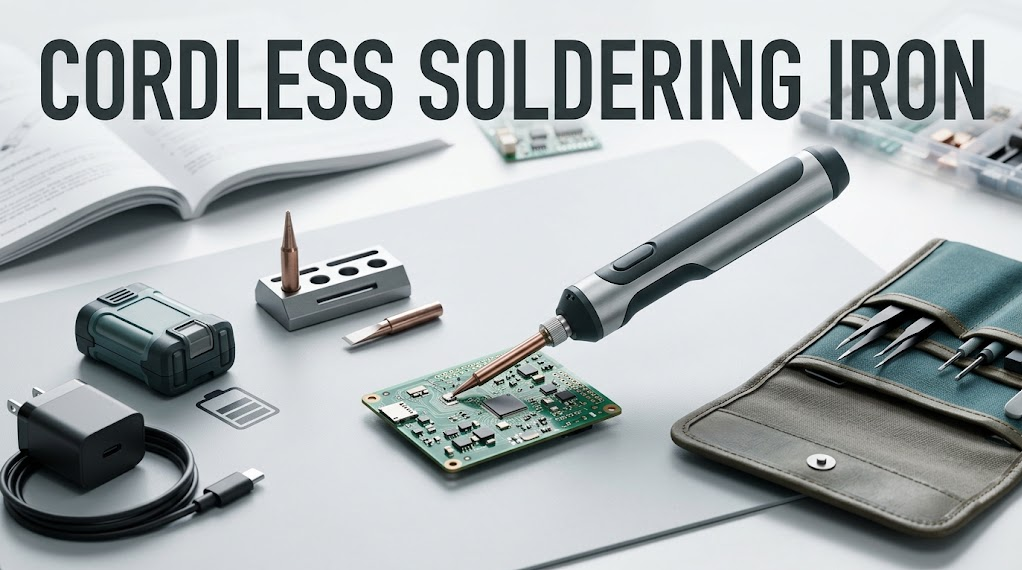
How Does a Cordless Soldering Iron Balance Power and Runtime?
A cordless soldering iron trades an always-available wall supply for portable energy. The design challenge is not simply to maximize heater wattage. It is to deliver enough heat to the joint, recover quickly after a large thermal load, protect the battery and electronics, and still provide useful runtime in the field. A high peak-power tool can feel fast but drain a small battery quickly; a low-power tool can last longer but struggle with ground planes or heavy connectors.This guide explains the tradeoff without promising a universal runtime. It shows how to estimate energy, read USB-C power claims, compare portable power options, and build a safer field kit. QUICKO product links are commercial references; verify the exact model, battery, charger, tip family, input requirements, and regional compliance before purchase.
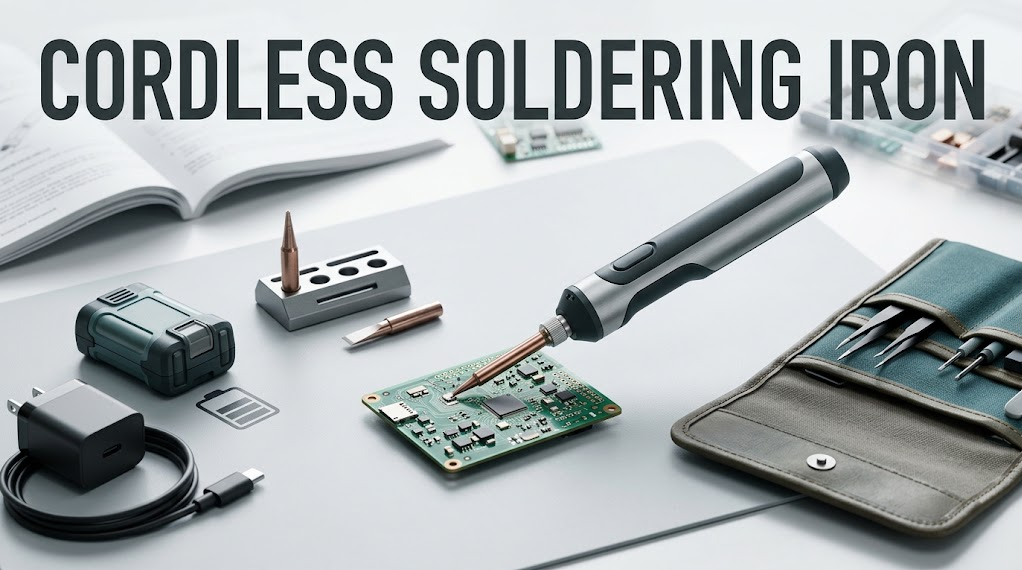
Quick Answer: What Determines Cordless Soldering Iron Runtime?
Runtime is determined by usable battery energy, system efficiency, and average electrical power over the work session. A useful planning estimate is runtime approximately equals usable battery watt-hours multiplied by system efficiency, divided by average electrical watts. Average power is lower than the heater's peak rating when the controller cycles, sleeps, or spends time at idle, but it rises during heat-up and recovery. Tip size, joint mass, temperature setting, ambient conditions, and battery age all change the result.What r/soldering Discussions Reveal About Portable Tools
Posts and comments in the r/soldering community repeatedly frame the same practical questions: will a power bank sustain heat, why does a portable tip cool on a ground plane, how many spare batteries are sensible, and is a USB-C cable really rated for the claimed power? These discussions are useful for discovering real user concerns, but they mix different tool architectures and are not controlled measurements.The recurring lessons are consistent with the engineering model in this article:
- A display can remain on while a source current limit causes heater power to collapse under load.
- A narrow tip may appear hot in air yet lose heat rapidly when it touches a large copper area.
- Runtime reports are not comparable unless the same tip, setpoint, duty cycle, battery state, and workpiece are described.
- USB-C is not a guarantee of high power. A source, cable, and tool must complete a compatible Power Delivery negotiation.
- Users often solve a heat-transfer problem by changing tip geometry or adding a small solder bridge rather than by increasing temperature.
Power, Energy, and Runtime: The Terms That Matter
Power is the rate of energy use, measured in watts. Energy is the amount available, commonly expressed in watt-hours. A tool can draw high power briefly during heat-up and much less while maintaining temperature. That is why a 60 W peak heater does not necessarily consume 60 W continuously.For a battery pack, the nominal energy estimate is:
`watt-hours = volts x amp-hours`
The usable energy is lower than the label estimate because the controller may reserve charge, the pack voltage changes with state of charge, conversion losses create heat, and protection circuitry may stop discharge before the cells are fully empty. Treat the result as a planning calculation, not a promise.
A transparent example
Suppose a pack is labeled 14.4 V and 2.0 Ah. Its nominal energy is 28.8 Wh. If a complete tool-and-converter system were assumed to use 30 W on average at 85% efficiency, the calculated runtime would be:`28.8 Wh x 0.85 / 30 W = 0.816 hours`
That is about 49 minutes as a calculated estimate, not a measured product result. A session with short joints and long idle periods could last longer; repeated recovery on large copper pads could be much shorter. Record measured runtime only after testing a defined workload and reporting the conditions.
Peak Heater Power Is Not Average Battery Draw
The heater supplies heat to the tip, but the battery also feeds the controller, display, sensors, conversion stage, and sometimes a fan or light. During heat-up, the controller may apply near-maximum power. Once the tip reaches the setpoint, it pulses the heater to replace heat lost to air and the workpiece. Sleep or standby modes reduce average draw but add wake-up time.Think in four states:
- Heat-up: high draw while the tip reaches the selected operating range.
- Active joint: high and variable draw while heat flows into solder, copper, connectors, or shields.
- Recovery: a short high-power burst after the joint removes heat.
- Idle or sleep: low draw while the iron rests, with occasional reheating or wake-up.
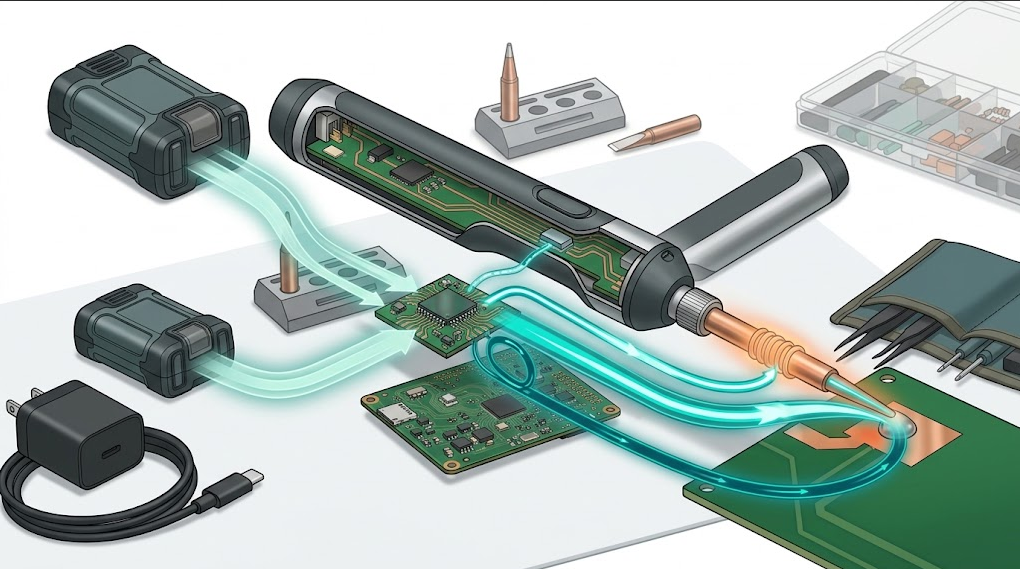
How USB-C Power Delivery Changes Portable Soldering
USB-C identifies the connector shape. Power Delivery is the negotiation system that allows a source and a device to agree on an available power contract. The USB Power Delivery specification overview explains that the device can request a suitable voltage and current rather than accepting one fixed output. USB PD 3.1 extends the possible range up to 240 W with the appropriate full-featured cable and equipment, but that ceiling does not mean every charger, cable, or soldering iron supports it.Before using a USB-C soldering iron in the field, verify:
- The tool's documented input range and required PD profiles
- The charger or power bank's supported output profile and sustained current
- The cable's current and power rating, connector condition, and length
- Whether the source shares power with a laptop, phone, or other load
- Whether the tool falls back safely when negotiation fails
Battery Chemistry and Thermal Safety
Portable tools commonly use rechargeable lithium-ion packs, but the chemistry, protection board, enclosure, and charging method vary by product. OSHA's lithium-battery safety guidance highlights hazards including thermal runaway, damaged cells, improper charging, and incompatible equipment. This article does not recommend opening a pack, replacing cells, bypassing protection, or charging with an unapproved source.Keep a battery out of service if it is swollen, leaking, cracked, unusually hot, wet, or emitting an unfamiliar odor. Do not carry a loose pack with metal objects that can bridge its terminals. Store and transport it according to the manufacturer's instructions and applicable local rules. A battery that becomes hot during normal low-load charging or discharging should be investigated; a rapidly heating or damaged pack should be isolated and escalated.
Choosing Tip Geometry for Heat Recovery
Tip geometry is a power multiplier. A broad chisel or bevel can transfer heat into a large pad more effectively than a fine conical tip, even when both are set to the same temperature. The correct choice still depends on access, component spacing, solder volume, and the tool's approved cartridge family.For a field kit, match the tip to the work you actually carry:
- Fine conical or small bevel for accessible, low-mass signal joints
- Medium chisel for wires, headers, and general rework
- Larger chisel or bevel for shields, ground planes, and high-mass connectors when the tool supports it
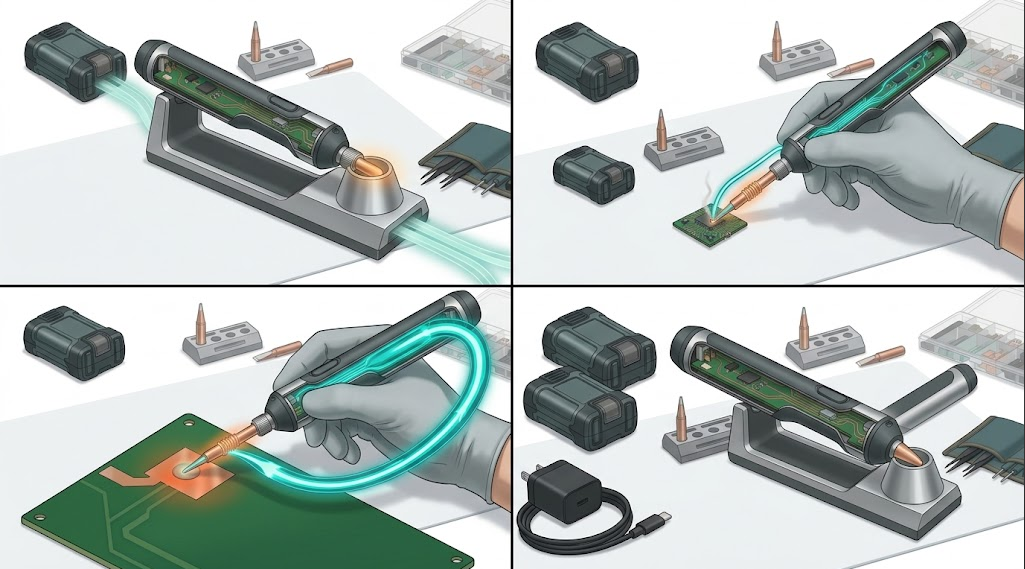
Comparing Portable Power Options
| Power option | Strengths | Tradeoffs to verify | Best fit |
|---|---|---|---|
| Internal or removable battery | Fast setup and no cable to a source | Energy capacity, aging, charging time, replacement availability, transport rules | Repeated field repairs with predictable duty cycles |
| USB-C PD source | Uses chargers and power banks already in a kit | PD profile, cable rating, shared-load behavior, connector wear | Mobile service where approved PD equipment is available |
| Butane | High portability and no electrical cable | Fuel handling, ventilation, flame and catalytic-heater safety, temperature control | Outdoor or utility work where regulations and training allow |
| Corded station | Continuous energy and strong recovery for long sessions | Requires outlet, stand, cable management, and appropriate site safety | Bench work, production, and heavy thermal loads |
The right choice depends on the work pattern, not on portability alone. A service team that performs ten short repairs may value quick wake-up and a spare pack. A bench technician working on large copper planes may prefer a corded station with a larger thermal reserve. A B2B buyer should compare total kit cost, accessory availability, serviceability, warranty terms, and operator training.
Build a Practical Field-Soldering Kit
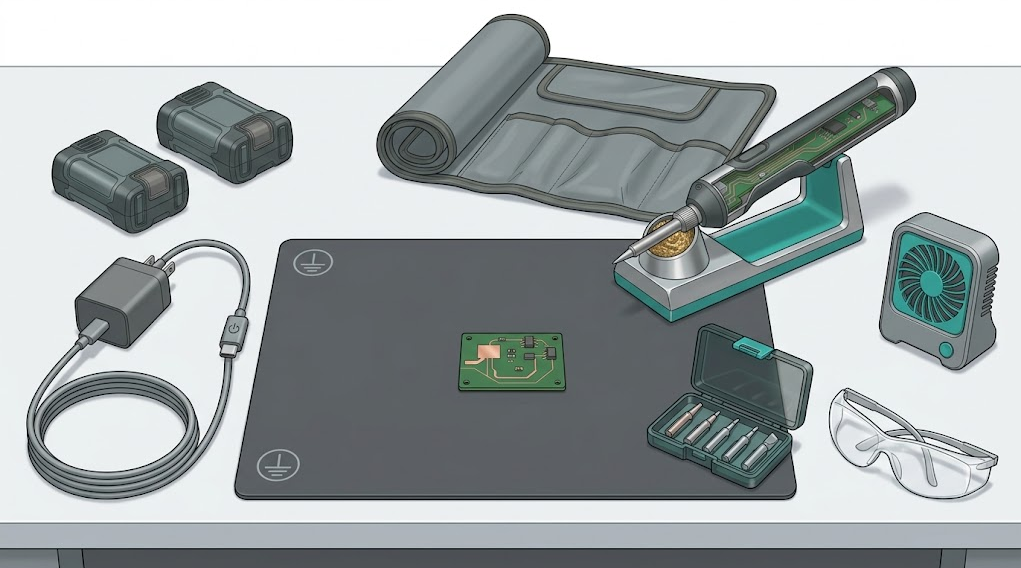
A cordless soldering iron is only one part of a reliable field setup. Pack the accessories that protect uptime and safety:- Approved spare battery or USB-C PD source, kept separate from metal objects.
- Correctly rated cable and charger, with a backup cable if the workflow depends on USB-C.
- Stable stand or heat-resistant rest so the hot tool is never placed on a vehicle seat, carton, or bare bench.
- Two or three compatible tips covering fine, general, and high-mass joints.
- Brass-wool cleaner, fresh solder, compatible flux, and a small waste container.
- ESD mat or wrist-strap equipment where the board and workplace require it.
- Safety glasses, local fume extraction, and a pouch that keeps hot and battery items separated.
A Simple Runtime Planning Worksheet
Before a site visit, write down the expected work rather than guessing from a marketing runtime number:- Count the number of joints and classify them as small, medium, or high-mass.
- Estimate active soldering minutes and idle or sleep minutes separately.
- Record the tip geometry and setpoint range required by the work instructions.
- List the battery or PD source, its nominal watt-hours or documented output, and the backup plan.
- Add a reserve for cold weather, battery aging, unexpected rework, and recovery delays.
- After the job, record start state, end state, number of recoveries, resets, and any abnormal heat.
Stop Conditions for Portable Tools
Stop using the tool and isolate it when the battery swells, leaks, becomes abnormally hot, or smells unusual; when a USB-C plug, cable, or port heats or discolors; when the tool resets repeatedly under load; when the tip heats without control; when insulation is damaged; or when conductors are exposed. Do not continue a job to “use the last charge” after a safety warning. Follow the product manual and local hazardous-battery disposal rules.For mains-connected chargers and stations, consult OSHA electrical-safety resources and your workplace procedures. Qualified service is required for insulation, protective-earth, leakage, mains-side, and enclosure repairs.
Frequently Asked Questions
Is a higher-watt cordless soldering iron always better?
No. Higher peak power can improve heat-up and recovery, but it can also increase source current, battery size, heat, and cost. Tip geometry, controller efficiency, and the duty cycle of the real joint matter just as much. Choose enough recovery for the largest approved load, then compare usable energy and service requirements.How can I estimate runtime without a product test?
Multiply nominal battery volts by amp-hours to obtain watt-hours, apply a conservative efficiency assumption, and divide by the estimated average electrical power. Label the result as calculated. Do not publish it as measured runtime. Validate later with a defined tip, setpoint, workload, ambient condition, and battery state.Does every USB-C charger work with a USB-C soldering iron?
No. The tool may require a particular Power Delivery profile and sustained current. Check the tool, charger, cable, and power bank as one system. A USB-C connector can physically fit while still failing to negotiate enough power or while falling back to a low-power mode.Why does my portable iron cool on a large copper pad?
The pad can remove heat faster than the tip and heater can replace it. Try a larger approved tip, improve the thermal bridge with fresh solder and compatible flux, preheat the work when the process allows, and use a source that meets the tool's documented power requirement. Raising temperature blindly can damage pads and components.Can I carry a spare lithium battery in a toolbox?
Only when the battery is protected from short circuits, damage, moisture, and incompatible charging. Follow the battery maker's transport instructions and local rules. Never carry a swollen, leaking, cracked, or unusually hot pack. If the pack is damaged, isolate it and arrange proper evaluation or disposal.Should a production team standardize on one portable power system?
Standardization often reduces training and spare-part complexity, but only after the team maps joint types, duty cycles, tip families, charger availability, ESD needs, and service coverage. Run a documented pilot on representative work. Compare total cost of ownership and downtime, not just the iron's purchase price or headline runtime.Conclusion
A cordless soldering iron balances power and runtime through four linked decisions: how much heat the joint needs, how efficiently the controller delivers it, how much usable energy the source stores, and how the operator manages the duty cycle. Use watt-hours and average power for transparent planning, verify USB-C PD as a negotiated system, match tip geometry to thermal load, and carry a stand, compatible tips, and a safe backup source.The next step for QUICKO buyers is to define the real field workload, request the exact model documentation, and record a controlled pilot. If the tool shows abnormal battery heat, unstable power, uncontrolled temperature, or damaged insulation, stop and send it to qualified service.


Linkedin:


