
 Tel:+86-13713635953
 Email:support@quicko.com.cn


How to Choose a Cordless Soldering Iron for Field Repair
How to Choose a Cordless Soldering Iron for Field Repair
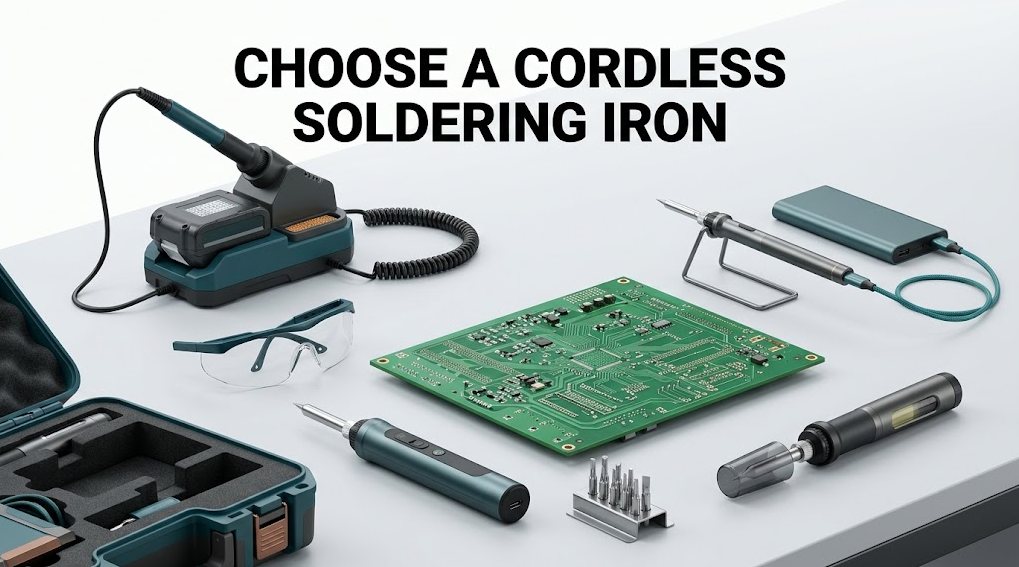
To choose a cordless soldering iron, start with the repair workload rather than the advertised wattage or maximum temperature. Define the smallest and largest joints, expected session length, available power sources, working environment, tip access, transport restrictions, and service requirements. Then select the tool architecture that can recover heat on the largest approved joint while remaining safe and manageable for the smallest one.This guide is for technicians, hobbyists, service teams, and buyers who need a portable soldering tool away from a fixed bench. It compares tool-battery stations, USB-C PD irons, internal-battery irons, and butane tools. It also includes a weighted selection worksheet and a controlled field-pilot method so the final choice is based on evidence instead of a headline specification.
Quick Answer: What Should You Check Before Buying?
Choose a cordless soldering iron by checking seven things: representative joint thermal mass, heat recovery, power-source compatibility, usable runtime, temperature control, tip availability, and field safety. Add ergonomics, repairability, warranty, and total kit cost before deciding. A no-load heat-up time is not enough; the tool must repeat acceptable joints on your real connectors and boards without resets, unsafe heating, excessive dwell, or an impractical battery and cable burden.Start With the Field Repair, Not the Tool
Write a one-page workload brief before comparing products. Include at least three representative jobs: the smallest precision joint, the most common joint, and the largest thermal load. A sensor pad, a wire-to-terminal joint, and a shield or ground-plane connection may require different tip geometry and recovery even when the solder alloy is the same.Record these conditions:
- Joint type and thermal mass: pad size, wire gauge, connector body, ground plane, shield, or metal chassis.
- Access: open bench, cabinet, vehicle, rooftop, crawlspace, mast, or other confined position.
- Session pattern: number of joints, active minutes, idle minutes, and required turnaround between repairs.
- Environment: ambient temperature, wind, moisture risk, lighting, ventilation, and combustible materials.
- Available energy: charged tool batteries, USB-C PD source, vehicle DC source, mains outlet, or approved fuel.
- Process controls: ESD requirement, fume extraction, safety glasses, workholding, inspection, and documentation.
What r/soldering Purchase Advice Adds
In a cordless-soldering reliability discussion, the original need was convenience for occasional guitar, microcontroller, sensor, and protoboard work. Replies raised several useful selection questions: whether organizing a compact existing station would solve the setup problem, whether suitable tips are available, whether the heat source is regulated, and whether the tool remains controllable under load.The thread does not prove that one architecture is best. It shows why buyers should separate three problems:
- Setup friction: Is the real need cordless power, or simply a compact ready-to-use kit?
- Thermal performance: Can the tip recover on the intended joint without overheating smaller work?
- Lifecycle support: Can the buyer obtain compatible tips, batteries, cables, parts, and documentation later?
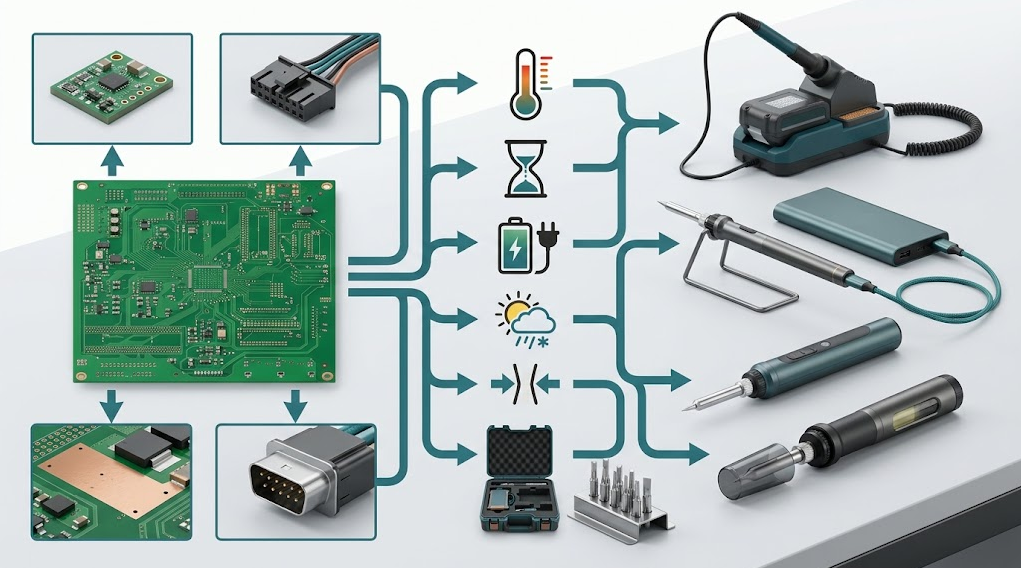
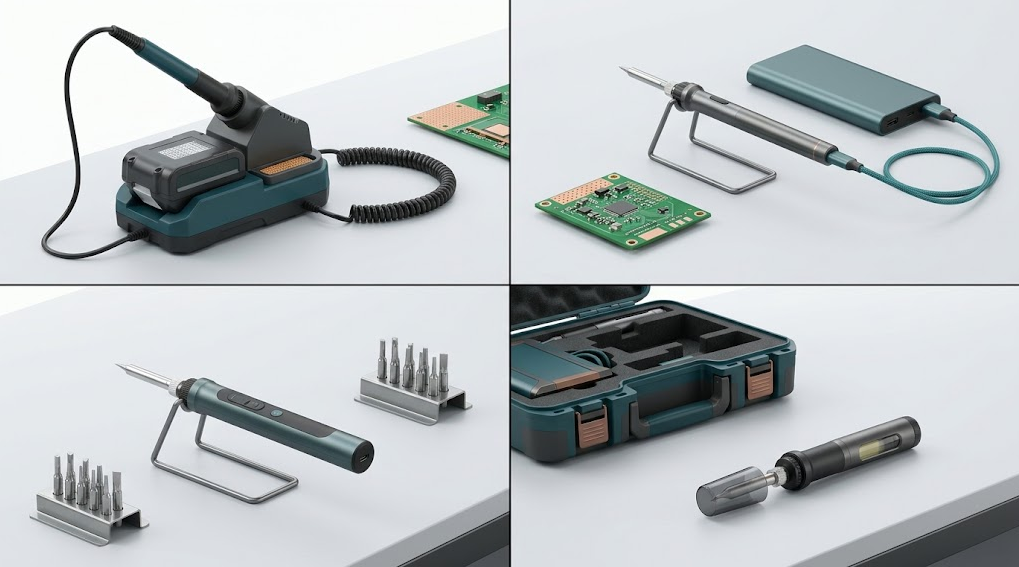
Compare the Four Cordless Soldering Architectures
Tool-battery soldering station
A tool-battery station uses a removable pack as the energy source and usually separates the controller from the handpiece. It can suit technicians who already manage a compatible battery fleet and want a cartridge-style handle, display, stand mode, and higher thermal capacity. The tradeoffs are pack weight, platform lock-in, battery protection, transport, and the need to confirm the exact adapter and voltage range.USB-C PD soldering iron
A USB-C PD iron is compact and can share an approved charger or power bank with other equipment. The USB Power Delivery specification overview explains that devices negotiate power over the cable. USB PD 3.1 supports up to 240 W in the appropriate full-featured ecosystem, but that is a protocol ceiling, not a promise for every iron. Verify the tool's requested profiles, the source's sustained output, and the cable rating together.Internal-battery soldering iron
An internal-battery iron minimizes separate components and can be convenient for short, low-to-medium-load repairs. Its limits may include fixed battery capacity, charging downtime, battery aging, and less field-replaceable energy. Ask whether the battery is serviceable, what protection and charge controls are used, and how the product is transported or disposed of at end of life.Butane soldering iron
A butane iron removes the electrical source and can offer fast refueling, but it introduces fuel, ignition, ventilation, storage, and temperature-control considerations. It may fit certain outdoor wire or heat-shrink tasks where local rules allow it. It is not automatically the right choice for ESD-sensitive boards, confined spaces, combustible environments, or fine work requiring closed-loop electrical temperature control.| Architecture | Main selection advantage | Main verification burden | Often suitable for |
|---|---|---|---|
| Tool-battery station | Replaceable energy and station-style control | Battery platform, adapter, protection, weight, cartridge compatibility | Repeated service jobs and mixed thermal loads |
| USB-C PD iron | Compact shared-power ecosystem | PD profiles, source, cable, connector wear, power-bank behavior | Precision electronics and mobile kits |
| Internal-battery iron | Simple self-contained package | Usable runtime, recharge delay, battery aging, serviceability | Short occasional repairs |
| Butane iron | No electrical source cable | Fuel rules, ventilation, ignition, regulation, storage | Approved outdoor or utility work |
Evaluate Thermal Performance Under Load
Maximum temperature is a weak selection metric by itself. A tip can reach a high temperature in air and still cool excessively when it contacts a large copper plane. Evaluate the complete heat path: controller, power stage, heater, sensor, cartridge contact, tip geometry, surface condition, solder bridge, and joint mass.Ask the supplier for documented answers to these questions:
- Is temperature controlled by a sensor close to the working tip, or only by an open-loop power setting?
- What happens when the source cannot provide the requested current?
- Does the display show set temperature, measured temperature, or an estimated value?
- Which tip or cartridge families are approved, and which geometries are available?
- Are sleep, wake, boost, calibration, and protection behaviors documented?
- Is recovery performance reported on a defined load rather than only as no-load heat-up time?
Verify the Complete Power System
For a tool-battery product, confirm the exact compatible battery model, nominal voltage, protection behavior, mechanical retention, adapter design, and low-voltage cutoff. A physically fitting pack is not proof of electrical compatibility. Do not use improvised wiring or an unverified adapter in a field kit.For USB-C, verify four parts as one system:
- The iron's documented USB PD profiles and maximum input.
- The charger's or power bank's supported output profiles and sustained capacity.
- The cable's current and power rating, connector condition, and length.
- The behavior when negotiation fails or the source reaches its current limit.
Estimate Runtime Without Believing a Universal Number
Runtime depends on usable energy and average electrical draw, not only the heater's peak rating. A planning estimate is:`runtime = usable battery watt-hours x system efficiency / average electrical watts`
For a battery pack, nominal energy is:
`watt-hours = volts x amp-hours`
Label this result Calculated, not Measured. Average power changes across heat-up, active soldering, recovery, idle, and sleep. Tip size, joint mass, setpoint, ambient temperature, battery age, and source protection also affect runtime. Use the formula to compare scenarios, then run a pilot with a defined workload.
Check Tip Ecosystem, Ergonomics, and Serviceability
A field tool is useful only while its consumables and support remain available. Verify tip family, geometry range, local stock, replacement cost, cartridge retention, cable strain relief, connector availability, handle balance, stand stability, and warranty process. For a team, standardization may reduce training and inventory, but it can also create platform dependence.The iFixit soldering and desoldering guide reinforces the need for power isolation, stable workholding, safety glasses, tip cleaning, and fume control. Those items belong in the buying decision because the smallest field kit still needs a safe place for the hot tool and a controlled workpiece.
Ask operators to evaluate:
- Grip comfort and control in the actual work posture
- Cable drag or battery weight at the wrist
- Visibility of the tip and joint under field lighting
- One-handed parking in the stand without tipping
- Glove compatibility where the work instruction requires gloves
- Pack size after charger, cable, stand, tips, consumables, and safety equipment are included
Use the QUICKO 100-Point Field Selection Worksheet
Score each candidate from 0 to 5 for every criterion, multiply by the weight, and divide by 5. The maximum total is 100 points. This is an editorial decision tool, not a laboratory certification.| Criterion | Weight | What a score of 5 requires |
|---|---|---|
| Thermal fit | 25 | Repeatable recovery on the largest approved joint without damaging the smallest work |
| Power and runtime fit | 20 | Verified source compatibility plus sufficient measured pilot reserve |
| Tip ecosystem | 15 | Required geometries, traceable compatibility, and practical replacement supply |
| Safety and controls | 15 | Stable stand, documented protection, controlled temperature, safe battery/fuel handling |
| Ergonomics and portability | 10 | Manageable complete-kit size and good control in real field posture |
| Serviceability and support | 10 | Current manual, warranty path, parts, accessories, and supplier response |
| Total ownership cost | 5 | Tool, source, spares, tips, charger, transport, training, and downtime included |
Calculated example: if a candidate scores 4, 3, 5, 4, 3, 4, and 3 respectively, its weighted total is 77/100. That number ranks candidates against the same workload; it does not prove quality or safety. Set a separate non-negotiable rule that any safety or compatibility failure disqualifies the candidate regardless of total score.
Run a Controlled Field Pilot Before Standardizing
Use the same source, cable, tip condition, solder, flux, setpoint, workholding, and inspection method for every candidate. Select three representative joints and complete at least five repetitions of each. Record heat-up behavior, recovery, dwell time, joint appearance, rework, resets, battery state, cable or connector heating, operator comfort, and pack setup time.Do not turn the pilot into an energized internal repair. Stop for uncontrolled heating, swelling, leakage, unusual odor, hot connectors, exposed conductors, repeated source protection, unstable temperature, or damaged insulation. OSHA lithium-battery safety guidance describes hazards from damaged cells, improper charging, and thermal runaway; follow the exact battery maker's instructions and workplace rules.
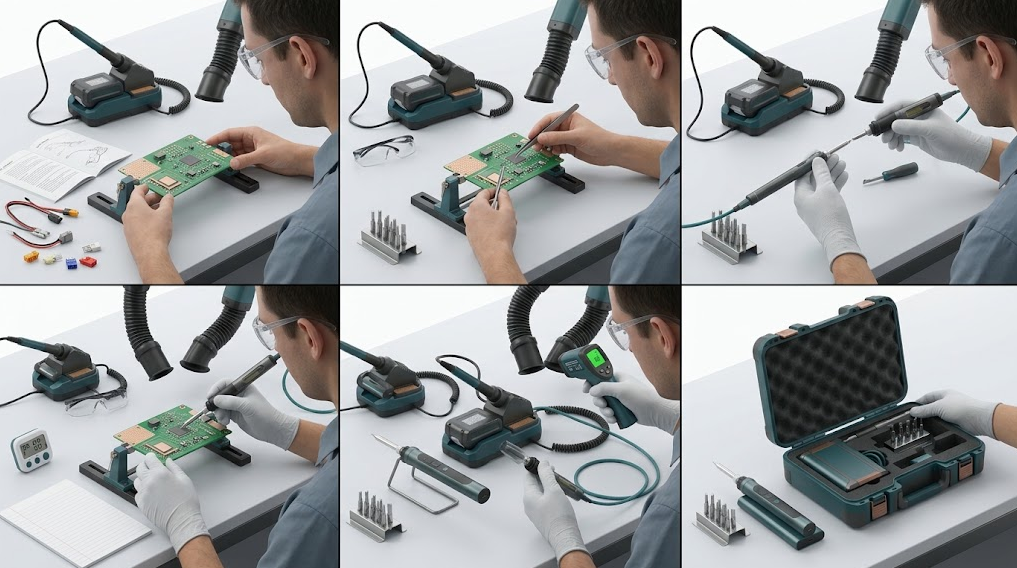
How QUICKO Buyers Can Shortlist a Model
Start with the QUICKO C210/C245 cordless soldering station only as a catalog reference. The page describes battery-platform and auxiliary-power options, cartridge compatibility, display functions, sleep behavior, and protection features. Because catalog fields can change or describe different configurations, request the current manual and a written configuration confirmation before ordering.For a B2B request, send the supplier this checklist:
- Exact model, controller revision, handle, and included cartridge
- Approved battery models, voltage range, adapter, and low-voltage behavior
- Approved DC or USB-C input profiles and cable requirements, if applicable
- Tip or cartridge family and the three required geometries
- Sleep, wake, boost, calibration, fault-code, and protection documentation
- Regional plug, compliance, warranty, replacement-part, and lead-time information
- Sample or pilot process for the representative workload
Frequently Asked Questions
What wattage should a cordless soldering iron have?
There is no universal wattage. Choose enough controlled power and thermal recovery for the largest approved joint, using a suitable tip and documented source. Compare performance on a representative copper load. Peak wattage, no-load temperature, and heat-up time cannot by themselves predict joint performance or battery runtime.Is a USB-C soldering iron good for field repair?
It can be, especially for precision electronics when an approved USB PD source and cable are already available. Verify the required power profiles, cable rating, connector durability, tip ecosystem, and behavior under load. A physical USB-C connection does not guarantee that the source can sustain heater demand.Is a tool-battery soldering station better than a pencil iron?
It may provide replaceable energy, a stable controller, and a broader cartridge system, but the complete kit is larger and tied to a battery platform. A pencil iron may be lighter and easier in tight spaces. Compare both on the same joints, posture, setup time, and transport requirements.Should I choose butane or battery power?
Choose by environment and process. Butane removes the electrical source but adds fuel, ignition, ventilation, and temperature-control constraints. Battery or USB-C tools can provide closed-loop electronic control but require charged sources and safe battery handling. Local rules and the workpiece may rule out one option before performance is compared.How many tips should a field kit carry?
Most kits should begin with three verified geometries: one for the smallest precision work, one general-purpose tip, and one for the largest approved thermal load. The exact shapes depend on access and cartridge family. Carrying many incompatible tips adds weight without improving field readiness.How do I compare cordless soldering iron runtime?
Define the battery energy, tip, setpoint, ambient condition, joint sequence, active time, and idle behavior. Use watt-hours divided by average power for a calculated estimate, then measure the same pilot on every candidate. Do not compare one maker's continuous-heating number with another maker's intermittent-use claim.Conclusion
To choose a cordless soldering iron for field repair, define the workload first, compare the four power architectures, verify the complete source and tip system, and run a controlled pilot. Rank candidates with the 100-point worksheet, but treat safety, compatibility, and documentation as pass/fail gates that no score can override.QUICKO buyers should submit the representative joints, work environment, battery or USB-C source, required tips, and duty cycle with the inquiry. That evidence gives the supplier a better basis for recommending a configuration and gives the buyer a test plan before standardizing the tool.


Linkedin:


