
 Tel:+86-13713635953
 Email:support@quicko.com.cn


T12 vs C210 vs C245 Soldering Tips: Which Fits?
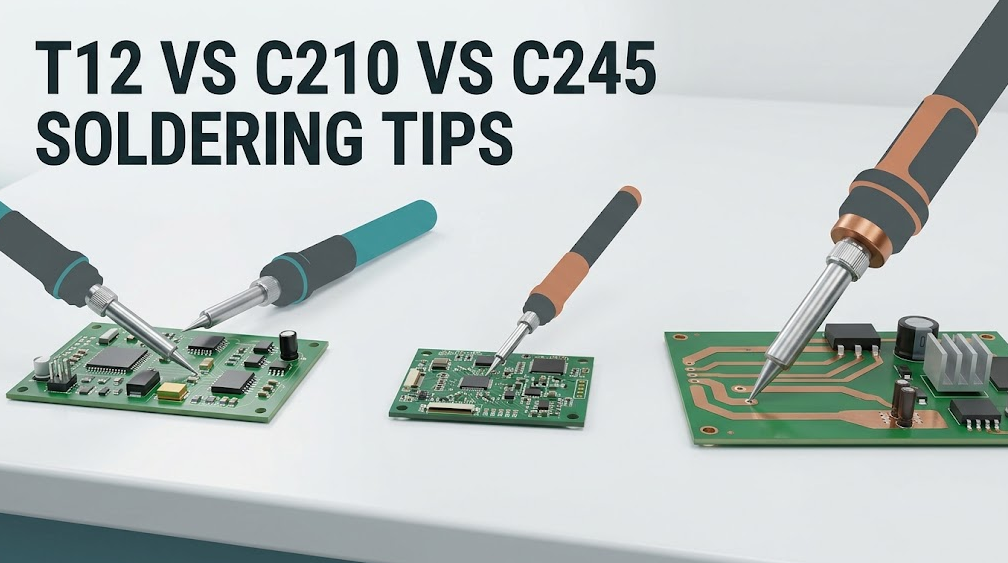
T12 vs C210 vs C245 Soldering Tips: Which Platform Fits Your Work?
Comparing T12 vs C210 vs C245 soldering tips is really a comparison of three cartridge ecosystems, not just three pieces of metal. C210 is usually the strongest fit for fine-pitch access and low-obstruction microscope work. C245 is the better starting point for connectors, shields, large pads, and sustained thermal loads. T12 remains a practical general-purpose choice when broad tip availability, familiar handles, and budget matter most.There is no universal winner. Tip geometry, cartridge mass, heater and sensor design, handle ergonomics, controller tuning, power delivery, grounding, standby behavior, replacement supply, and price all affect the result. This guide is for technicians, hobbyists, labs, educators, and buyers who want a defensible way to choose a platform without relying on a single wattage number or an online speed claim.
|
Commercial disclosure QUICKO publishes this guide and sells soldering stations, handles, cartridges, and tips. QUICKO links are commercial links. General selection guidance is separated from product-specific claims. Confirm the exact cartridge, handle, controller, power supply, firmware, stand, grounding arrangement, and regional electrical requirements before purchase or use. |
|---|
Quick Verdict
- Choose C210 when most work happens under magnification on dense boards, small pads, fine leads, or restricted access points.
- Choose C245 when the workload often includes connectors, shield tabs, thick leads, large pads, or copper planes that pull heat from the joint.
- Choose T12 for a versatile general bench where replacement variety, widespread availability, and lower entry cost can outweigh the advantages of a more specialized family.
- Use two systems when the bench genuinely spans both microscope repair and heavy thermal work. One cartridge family can cover many jobs, but forcing one extreme tip to do everything often costs more time than a second handpiece.
Table of Contents
- T12 vs C210 vs C245 at a glance
- What changes when cartridge size changes?
- T12: the general-purpose ecosystem
- C210: the precision ecosystem
- C245: the higher-capacity ecosystem
- Thermal recovery and contact area
- Compatibility and controller boundaries
- Best platform by use case
- Cost, availability, and ownership
- Buyer checklist
- Frequently asked questions
T12 vs C210 vs C245 at a Glance
| Decision factor | T12 | C210 | C245 |
|---|---|---|---|
| Best starting role | General bench and mixed electronics | Fine-pitch and access-limited work | Larger joints and sustained thermal load |
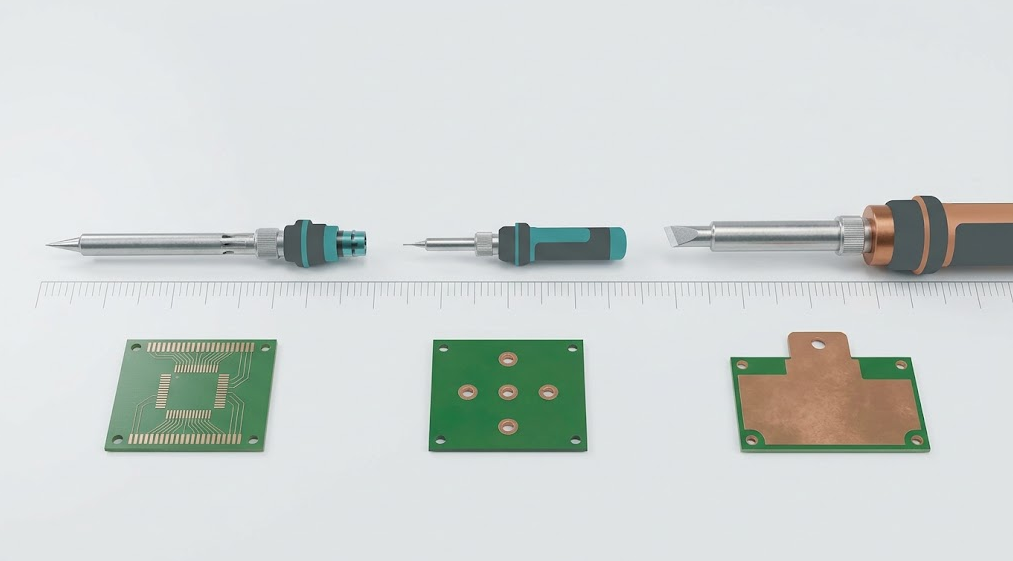
| Typical physical feel | Long, slim cartridge with broad aftermarket variety | Compact, light working end with close access | Larger cartridge and working end with more thermal mass |
| Strong use cases | Through-hole, wires, common SMD, hobby repair | Dense SMD, microscope work, small pads, fine leads | Connectors, shields, ground planes, thicker wire, repeated high-load joints |
| Main compromise | Quality and controller behavior vary widely across implementations | Can be inefficient when the joint is physically large or strongly heat-sunk | Can obstruct access or feel oversized around very dense components |
| Supply question | Usually broad choice, but consistency varies by seller | Confirm exact genuine or compatible range and handle support | Confirm shape range, handle support, and replacement cost |
| Buying priority | Ecosystem value and reliable controller implementation | Ergonomics, visibility, fine shapes, and stable control | Recovery under load, suitable larger shapes, and power delivery |
This table describes platform tendencies, not guaranteed performance. A well-designed station with the right chisel can outperform a poorly matched “more powerful” station using a needle tip. Cartridge branding alone does not overcome wrong geometry, oxidation, weak power delivery, poor controller tuning, or an unsuitable process.
What Changes When Cartridge Size Changes?
A cartridge system puts the heater and temperature-sensing elements close to the working end. That shortens the thermal path compared with many traditional irons, but the complete control loop still matters. The station must sense temperature change, deliver energy, and settle without excessive overshoot while the wetted face maintains contact with the joint.Three practical variables change across these families:
- Access. A smaller working end can reach between components and improve visibility under a microscope.
- Thermal reserve and contact options. A larger cartridge can support broader geometries and more metal near the joint, which helps when the work absorbs heat quickly.
- System burden. Larger loads demand suitable power delivery, controller behavior, cabling, and handle construction. A cartridge's theoretical capability is irrelevant if the station cannot drive it correctly.
T12 Soldering Tips: The General-Purpose Ecosystem
T12 is the broad middle ground in this comparison. It is associated with long composite cartridges and a large selection of conical, chisel, bevel, knife, and specialty shapes. The HAKKO FX-951 product page provides primary-source context for the T12 series within HAKKO's own station ecosystem. Third-party T12-compatible implementations are numerous, but their electronics, grounding, calibration, sleep logic, connectors, and construction are not automatically identical.For a mixed hobby or repair bench, T12 can cover through-hole parts, wires, common surface-mount packages, and moderate connector work when the right shape is available. A medium chisel is often a better default than the needle-like tip bundled with many stations. Buyers who already own the ecosystem can browse QUICKO's T12 soldering tip range and compare face width, reach, and geometry rather than choosing by name alone.
Surface finish is a separate purchasing variable, not proof of better performance. If finish, corrosion protection, or catalog options matter to your inventory plan, compare QUICKO's black-finish T12 tip options against the exact dimensions and supported station documentation before ordering.
T12's main advantage is ecosystem breadth. Replacement cartridges and handles are widely offered, and the entry cost can be attractive. Its main risk is variability. Two products advertised as “T12 compatible” may differ in controller tuning, power supply quality, grounding, connector pinout, calibration, handle contacts, and standby sensing. Treat the station and cartridge combination as one engineered system.
When T12 is the right choice
- Your work is a balanced mix of through-hole, common SMD, wiring, and repair.
- You want a broad tip catalog and easy replacement sourcing.
- Budget and total fleet cost matter more than minimizing handpiece size.
- You already have a proven T12 station, known-good cartridges, and documented settings.
When to look beyond T12
Move toward C210 when component density and microscope access are the daily constraint. Move toward C245 when large pads, shields, thick leads, and repeated high-load joints routinely expose the limits of your current tip geometry and station recovery.C210 Cartridges: The Precision Ecosystem
C210 is designed around a compact working end and precision-oriented cartridge range. JBC maintains a distinct official C210 cartridge range, including very fine conical and chisel geometries as well as shapes for specialized access. The important point is not that every C210 tip is microscopic; it is that the family gives the operator a smaller, less obstructive interface near the joint.That physical advantage matters under magnification. On dense phone, camera, wearable, or compact control boards, the operator often needs to see the lead, pad, solder meniscus, and neighboring components at the same time. A bulky working end can block the view even when its nominal tip face is small. C210 reduces that obstruction and can feel more agile during fine rework.
The tradeoff appears when the joint becomes a heat sink. A tiny cartridge and fine point cannot create a large contact patch on a connector shield or ground-plane pad. The station may maintain its displayed setpoint while the joint still heats slowly because the physical contact path is poor. Before increasing temperature, move to the widest supported C210 geometry that safely fits. If that is still marginal, C245 or controlled preheating may be the better process.
When C210 is the right choice
- Fine-pitch leads, small pads, jumper wires, and dense access dominate the workload.
- Microscope visibility and a light working end are more important than maximum joint size.
- The bench already has another tool for shields, large connectors, or heavy ground structures.
- Operators need repeatable precision more than a one-system-for-everything compromise.
C210 selection caution
Do not equate “smaller” with “safer.” A fine point that dwells too long can overheat flux, damage a pad, and encourage higher setpoints. Select the largest C210 face that fits the exposed metal and lets the operator leave the joint promptly.C245 Cartridges: The Higher-Capacity Ecosystem
C245 sits at the larger end of this three-way comparison. JBC's separate official C245 cartridge catalog contains many geometries intended for general soldering and higher-load work. The family is a strong starting point when the bench regularly encounters connector shells, shield tabs, large through-hole pins, broad pads, heavy copper, or thicker wire.The benefit comes from the complete match between cartridge, usable tip shape, handpiece, controller, and power delivery. A wider C245 chisel or bevel can create a stable solder bridge across more metal than a precision point. That lowers thermal resistance at the interface and helps the controller replace energy while the joint is absorbing it.
The compromise is physical access. A larger cartridge can hide fine leads under a microscope or contact nearby plastic and components if the operator chooses an oversized shape. C245 can still handle ordinary SMD and through-hole work with a suitable tip, but it is not automatically the most comfortable choice for the densest boards.
When C245 is the right choice
- Connectors, shields, terminals, and copper planes are routine rather than occasional.
- Production or repair work repeats thermally demanding joints throughout the day.
- You want a broad range of medium and larger geometries in one ecosystem.
- The controller, supply, handle, and stand are documented for the selected cartridge family.
When C245 is more than you need
If most tasks are tiny pads and fine leads, a large handpiece and cartridge can add visual obstruction without improving the joint. A smaller platform may reduce fatigue and improve placement accuracy.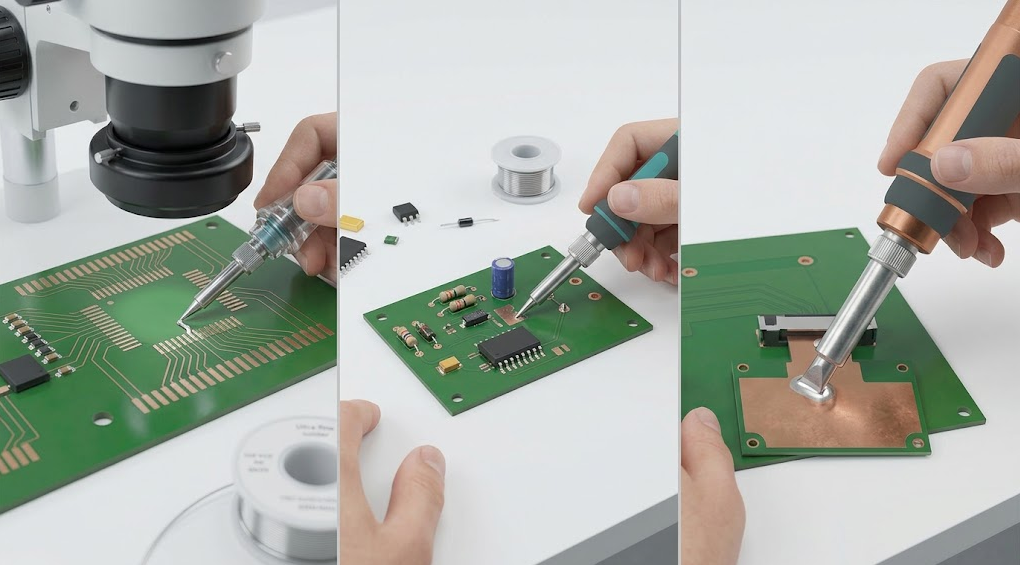
Thermal Recovery: Why Wattage Alone Does Not Decide
Station wattage is an input limit, not a direct measurement of heat entering the joint. Useful recovery depends on the power supply, controller algorithm, cartridge resistance, sensor placement, handle and connector losses, tip mass, working-face geometry, solder film, flux, and the assembly's copper and metal mass.This makes many online “heat-up race” comparisons incomplete. Starting from room temperature tests only one condition. Real work includes repeated joints, standby recovery, different tip shapes, varying contact pressure, lead-free and leaded process windows, and boards with very different heat sinking. Unless the same procedure, instruments, cartridges, shapes, loads, and acceptance criteria are documented, a claimed time advantage should not be treated as a universal ranking.
Use a simple bench validation instead:
- Select comparable chisel widths that safely fit the target joint.
- Use the same alloy, flux, board type, and preheat condition.
- Start each cartridge from the same documented state.
- Record setpoint, joint contact time, wetting result, overshoot signs, and recovery between repeated joints.
- Inspect the joint and nearby materials under magnification.
- Repeat enough times to separate a stable result from operator variation.
Compatibility: Similar Shape Does Not Mean Interchangeable
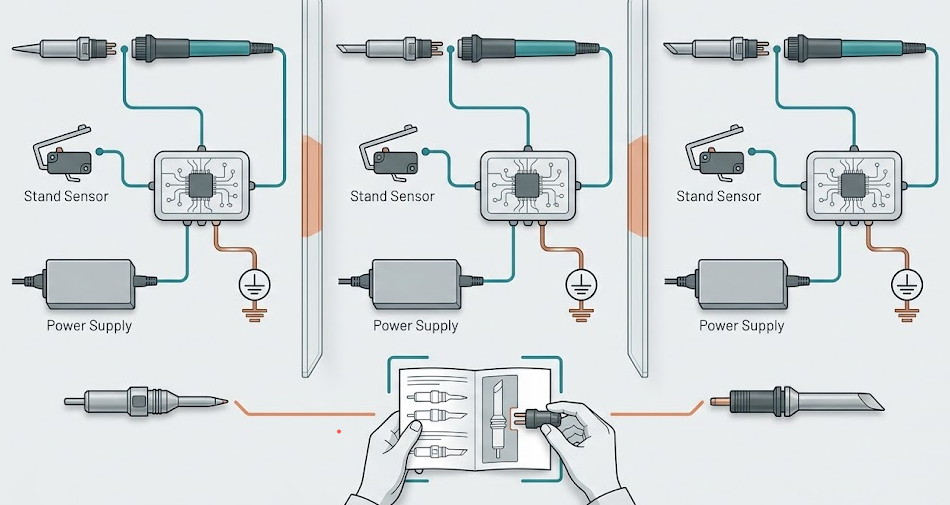
T12, C210, and C245 are separate ecosystems. Do not insert a cartridge into a handle merely because the diameter or contact layout appears close. Mechanical fit does not prove electrical compatibility, safe voltage, correct resistance, sensor type, pinout, controller tuning, grounding, insulation, firmware support, or stand behavior.Before using any cartridge and station combination, verify:
- The exact cartridge family and part number are listed for the handle.
- The handle is listed for the controller and its connector pinout.
- The power supply voltage, current capacity, isolation, and protective earth arrangement match the design.
- Tip-to-ground resistance and leakage meet the requirements of the work and applicable procedure.
- Stand detection, sleep, hibernation, calibration, and firmware behavior are supported.
- The selected tip geometry has clearance around components, plastics, coating, and fixtures.
Best Platform by Use Case
| Use case | Best starting platform | Why | Second choice or caveat |
|---|---|---|---|
| Fine-pitch IC leads under a microscope | C210 | Compact working end improves access and visibility | T12 with a small chisel can work when clearance is adequate |
| Mobile-device and dense-board repair | C210 | Fine shapes and low obstruction suit crowded assemblies | Keep a higher-capacity tool for shields and frames |
| General hobby electronics | T12 | Versatile range and accessible replacement ecosystem | Confirm controller quality and grounding |
| Through-hole headers and ordinary wiring | T12 or C245 | Both can support useful chisel geometries | Choose by existing ecosystem and joint mass |
| Connector shells and shield tabs | C245 | Larger supported faces suit broad metal areas | Safe preheat may still be needed on heavy assemblies |
| Large ground-plane pads | C245 | Greater practical capacity and broad contact options | Board construction and process limits still control the result |
| Teaching lab with mixed student projects | T12 | Cost and tip availability can simplify fleet support | Standardize one known-good station and approved tip list |
| Repair bench spanning phones and power electronics | C210 plus C245 | Each handpiece handles the workload it suits | A single T12 system is a compromise when budget or space is tight |
The paired-system recommendation is not an upsell. It is a process decision. A precision cartridge and a higher-capacity cartridge reduce the temptation to use an extreme setpoint, excessive dwell, or an awkward tip simply because it is the only tool available.
Cost, Availability, and Total Ownership
Purchase price is only the first line of cost. Compare the complete set needed for twelve months of real work:- Controller, power supply, handle, stand, grounding accessories, and shipping.
- At least three useful tip shapes rather than one bundled point.
- Replacement cartridges from a traceable supplier.
- Downtime when a handle, stand sensor, connector, or power supply fails.
- Calibration or verification needs for production and ESD-controlled environments.
- Operator retraining, documented settings, and spare inventory across multiple benches.
For organizations, create an approved-parts sheet containing station model, handle, cartridge family, three preferred tip shapes, supplier, revision date, grounding check, firmware version, and substitute policy. This prevents an emergency purchase from quietly introducing an unverified cartridge or controller combination.
Seven-Point Buyer Checklist
- List your five most common joints. Include pad or terminal size, nearby clearance, and whether the joint connects to a copper plane.
- Separate precision from thermal-load work. Estimate how often each category occurs rather than choosing from one memorable difficult job.
- Choose three tip geometries. A small chisel, medium chisel, and wider chisel or bevel usually reveal more than a catalog's total shape count.
- Verify the complete compatibility chain. Cartridge, handle, controller, supply, stand, firmware, and grounding must be documented together.
- Check local replacement supply. Confirm current stock, delivery time, authenticity controls, and the cost of keeping spares.
- Run a representative coupon test. Compare equivalent shapes on real board constructions and record the process.
- Document the decision. Keep approved part numbers, settings, cleaning method, safety checks, and review date with the bench procedure.
Safety and Process Note
Soldering involves hot tools, molten metal, flux fumes, sharp leads, and electrical equipment. Use eye protection, suitable ventilation or fume extraction, a stable heat-resistant stand, and the solder and flux maker's safety instructions. Wash hands after handling lead-containing solder and keep food and drink away from the bench. Follow the assembly, component, board, and workplace process limits rather than copying a universal temperature from an article.TWI's explanation of how soldering joins materials without melting the base parts provides useful process context: the goal is controlled heat transfer and wetting at the joint, not simply the highest available tip temperature.
Frequently Asked Questions
Is C210 better than T12 for SMD work?
C210 is usually the better starting point for dense, fine-pitch SMD work because its compact working end improves microscope access and visibility. T12 can still perform ordinary SMD soldering well with a small chisel and a stable controller. Choose based on component density, joint thermal load, ergonomics, and replacement support rather than the SMD label alone.Is C245 more powerful than T12?
C245 is generally positioned for larger cartridges and higher thermal loads, but “more powerful” is incomplete without the controller, supply, tip geometry, and test load. A correctly driven C245 system is a strong choice for connectors and planes. A well-matched T12 chisel may still be faster and safer than an unsuitable C245 point on a particular joint.Can C210 and C245 tips use the same handle?
Do not assume so. C210 and C245 are separate cartridge families, and a product may use different handles or a purpose-designed multi-family arrangement. Similar appearance is not evidence of compatibility. Use only combinations explicitly supported by the current handle, controller, power supply, firmware, and manufacturer or seller documentation.Which is best for a beginner: T12, C210, or C245?
T12 is often the practical beginner choice for mixed hobby electronics because tips and compatible stations are widely available. C210 suits beginners focused on dense repair, while C245 suits larger connectors and high-load joints. A reliable controller, grounded safe construction, a medium chisel, a stable stand, and good instruction matter more than the family name.Should I buy one station or separate precision and heavy-duty tools?
Buy one system when most joints fall in the same range and a suitable tip catalog covers the exceptions. Use separate C210 and C245-class tools when the bench regularly moves between microscope repair and large thermal loads. The second handpiece can reduce tip changes, extreme settings, excessive dwell, and operator frustration.Conclusion: Choose the Workload, Then the Cartridge
The practical answer to T12 vs C210 vs C245 soldering tips is workload based. Choose C210 for fine access, C245 for larger thermal demands, and T12 for a balanced general bench with broad availability and value. None of those choices is complete until the tip face, handle, controller, power supply, stand, grounding, and replacement supply have been verified together.Start with five representative joints and three useful tip shapes. Test equivalent contact areas on the real board constructions you service, record the process, and purchase the platform that produces repeatable wetting with safe clearance and reasonable dwell. For QUICKO products, confirm the exact ordered configuration and current documentation before treating any cartridge family as supported.


Linkedin:


