
 Tel:+86-13713635953
 Email:support@quicko.com.cn


How to Choose a Cordless Soldering Iron to Repair?
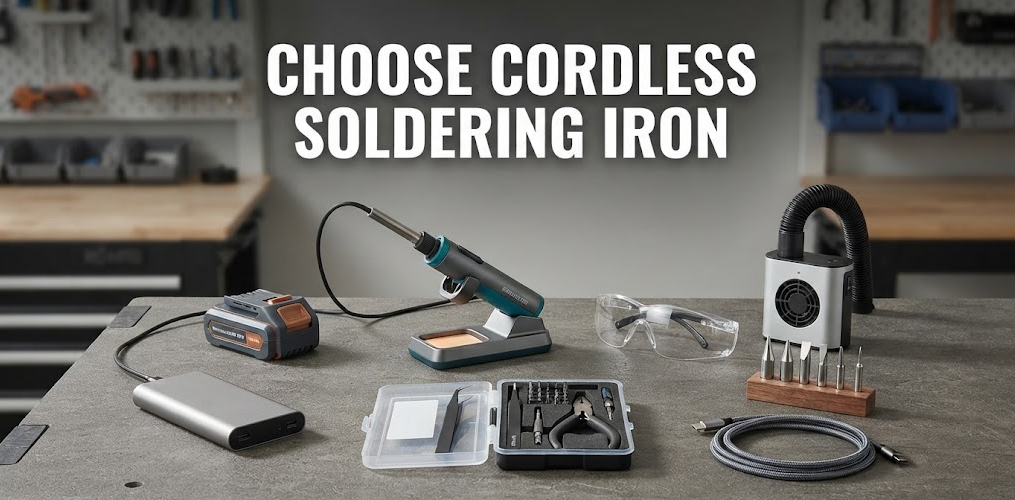
Commercial disclosure: QUICKO publishes this educational guide and sells soldering equipment and consumables. QUICKO links are commercial references. This guide does not claim that one power format, wattage, temperature, runtime, battery, cable, charger, or tip system is universally best.
Quick Navigation
· Define the repair mission· Apply pass/fail gates
· Compare cordless power formats
· Score candidates and test representative joints
· Avoid common mistakes
· Use the buyer and field-kit checklists
Choose a Cordless Soldering Iron by Mission, Not Marketing
Write a mission profile before comparing tools. List the real joints—fine PCB pads, shield cans, wire splices, terminals, or connectors—plus solder process, ventilation, work period, travel, environment, recharge access, and available tips. Separate occasional joints from repeated connector work because duty cycle changes the importance of recovery, battery logistics, and tool size.Also record the cost of a stopped job. For remote work or a fleet, spares, standardized configurations, training, labeling, and service access may matter more than a low handle price.
Apply Five Pass/Fail Gates Before You Score Features
Reject or pause a candidate when any required gate lacks evidence. A long feature list cannot compensate for unresolved safety or compatibility.| Gate | Evidence to request | Why it matters |
|---|---|---|
| Mission fit | Joint range, tip options, duty guidance, and test plan | Confirms that the tool addresses the work |
| Power-chain compatibility | Exact source, protocol, cable or adapter, connector, and inputs | Prevents a weak or incompatible link from limiting heat |
| Tip-system compatibility | Tip family, sensor/controller relationship, insertion method, and geometries | Mechanical fit does not prove control compatibility |
| Safety and transport | Instructions, battery documents, charging, storage, and workplace approval | Controls electrical, thermal, battery, and travel risk |
| Service continuity | Consumables, cables, batteries, warranty, and support | Keeps the field kit usable after wear or loss |
Treat ambiguous compatibility as unresolved. Ask for the exact model and revision; do not rely on photos or marketplace titles. The QUICKO Products page can identify current categories, but product documentation controls the decision. Use OSHA electrical safety guidance as general risk context, not as a replacement for instructions or qualified workplace controls.
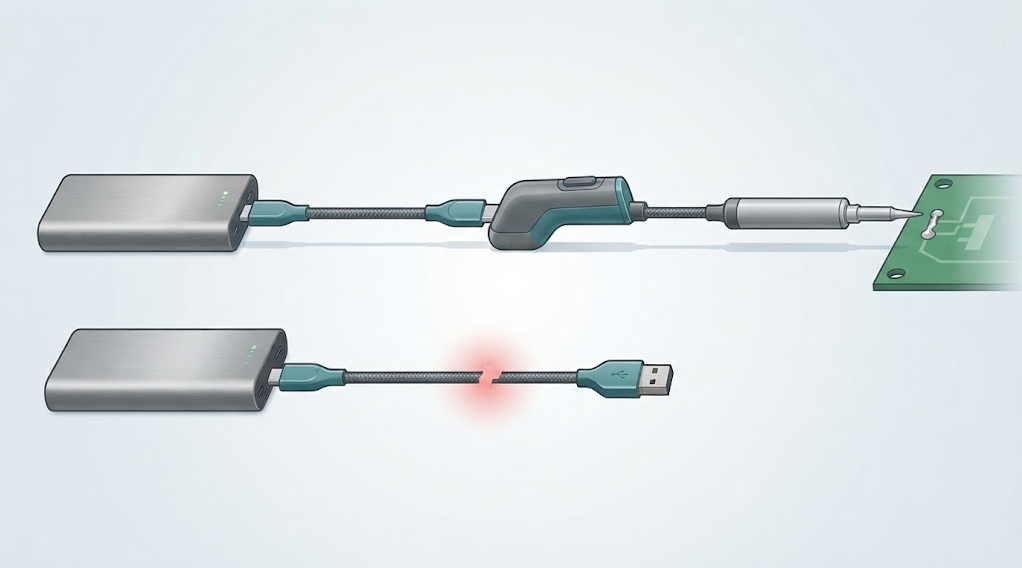
Evaluate the Complete Energy Chain
A cordless setup is a system: source → protocol → cable or adapter → controller → heater → tip → joint. Any weak or incompatible link can decide the result. A USB-C soldering iron may be limited by the source or cable; a removable-battery tool may be limited by battery condition, contacts, protection, or an unsupported adapter.For USB-C, request accepted input profiles and source and cable requirements. The USB-IF USB Power Delivery overview explains negotiated power, but a USB-C plug alone proves neither PD support nor adequate output.
For battery tools, document the approved battery family, charger, condition limits, storage, and replacement path. Never improvise an adapter or bypass protection. For air travel, check current FAA PackSafe lithium-battery guidance, carrier rules, and every route’s regulations.
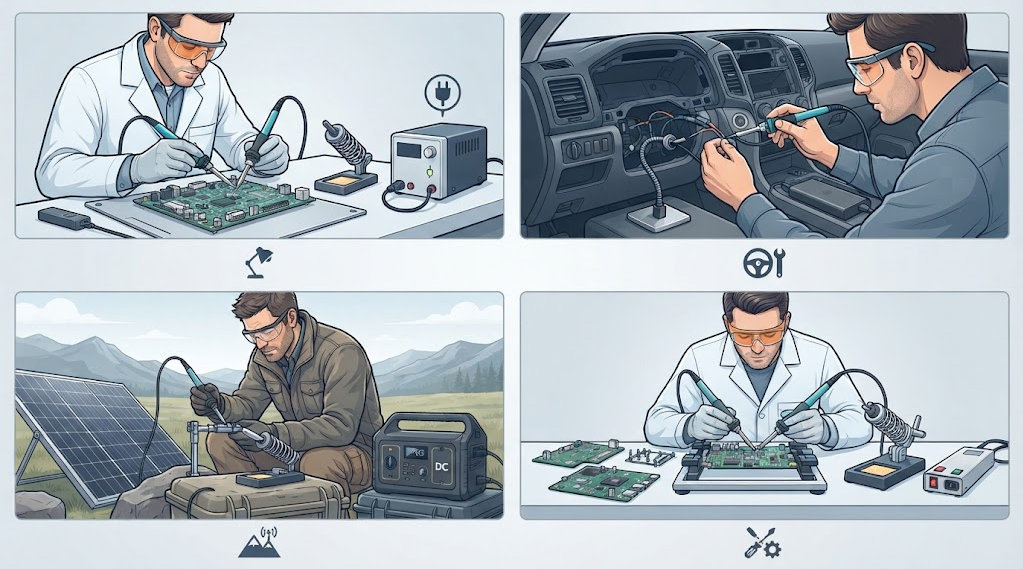
Compare Power Formats Against the Application
| Power format | Often useful when | Resolve before purchase | Planning trade-off |
|---|---|---|---|
| USB-C PD | Shared portable power is already carried | Profiles, cables, power banks, and low-charge behavior | Flexible sources; the negotiated chain must match |
| Removable tool battery | A team manages one approved platform | Exact battery approval, availability, protection, and portability | Fast swaps; more platform lock-in |
| Internal battery | Light work and one compact package matter | Serviceability, charge indication, and near-empty behavior | Fewer parts; battery aging affects the whole tool |
| Portable DC | A vehicle or cart supplies controlled power | Voltage, polarity, connector, fuse, and cable | Stable setup; less pocketable and easier to misconnect |
| Fuel-powered | No electrical source exists and site rules permit it | Flame, fuel, ventilation, ignition, and transport controls | Independent power; prohibited in many environments |
This table screens formats; it does not rank products. Site or transport rules may eliminate a format before performance testing.
Score Only the Candidates That Pass the Gates
Weight the surviving candidates against the mission. One team might use 30% representative-joint performance, 20% power-chain reliability, 15% tip availability, 15% ergonomics, 10% serviceability, and 10% ownership cost. This is an example; set weights before testing.Score only documented or observed evidence. Include the verified source, cable or adapter, batteries, charger, tips, stand, storage, spares, training, and downtime in cost. Keep gate failures separate so features cannot conceal a safety or compatibility rejection.
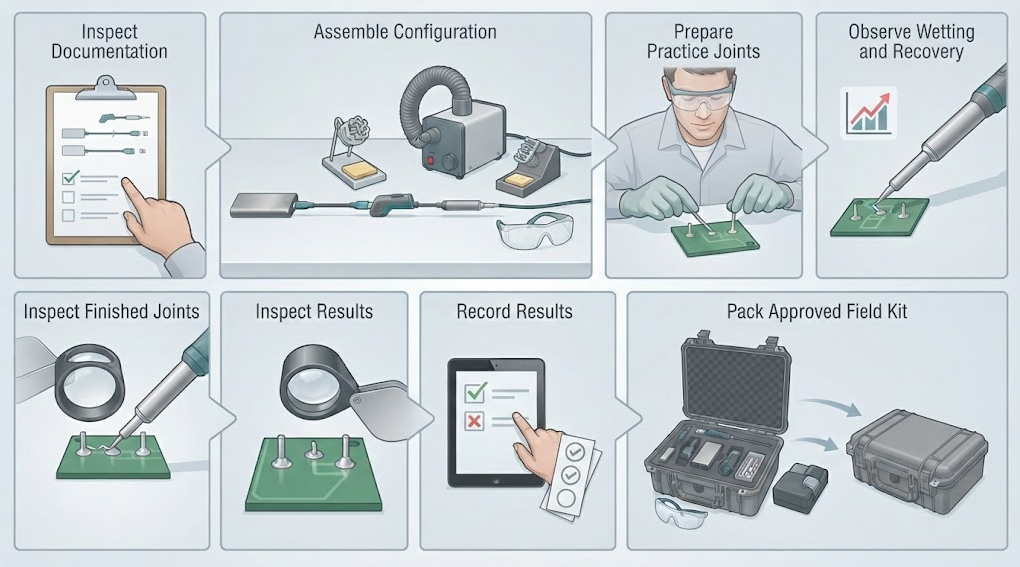
Run a Representative-Joint Acceptance Test
Test the exact proposed kit in a safe area with a stable stand, eye protection, and fume control. The iFixit soldering guide supplies general technique context; product and workplace procedures remain controlling.1. Record tool, revision, source, battery, cable or adapter, firmware, tip, solder, flux, ambient condition, and charge state.
2. Inspect equipment and documents. Stop for damage, swelling, contamination, loose contacts, odor, or an unsupported combination.
3. Prepare at least three practice joints that represent the work, including the largest safe thermal mass.
4. Observe startup, recognition, wetting, dwell, recovery, control, ergonomics, errors, and protection events.
5. Inspect for adequate wetting, bridges, lifted pads, insulation damage, or excessive heating.
6. Repeat at the lowest field-relevant charge state allowed by the instructions.
7. Approve only when every predeclared criterion passes; quarantine failed configurations.
Do not invent universal temperature, heat-up, runtime, or pass limits. Thresholds depend on the assembly, materials, instructions, and controls. This draft reports no first-party QUICKO test result.
Common Cordless Soldering Iron Buying Mistakes
Buying by headline wattage alone
Power does not describe negotiation, cable loss, controller behavior, tip contact, or recovery. Verify the complete configuration on real work.Assuming every USB-C source and cable works
USB-C is a connector family, not a guaranteed power result. Confirm protocol, profiles, cable capability, and fallback behavior.Treating mechanical tip fit as compatibility
A fitted tip may use different contacts, sensor behavior, depth, calibration, or controller logic. Require written compatibility.Ignoring depleted-battery behavior
Include an approved low-charge test, recharge or swap plan, and safe spare-battery policy.Skipping spares and configuration control
Unavailable tips, cables, batteries, or service create downtime. Label approved kits, restrict substitutions, and retain test records.Final Selection Checklist
· [ ] Mission lists joints, environment, duty cycle, travel, and downtime cost.· [ ] Tool, revision, source, protocol, cable or adapter, battery, charger, and tips are documented.
· [ ] Safety, charging, storage, transport, and workplace requirements are approved.
· [ ] At least three representative joints pass predeclared criteria.
· [ ] Low-charge and recharge or swap workflows are verified.
· [ ] Stand, fume control, eye protection, storage, and hot-tip handling are practical.
· [ ] Warranty, repair route, spares, support, and total ownership cost are confirmed.
· [ ] Every approved fleet configuration and substitution is recorded.
Field Kit Checklist
· Approved iron, current instructions, and configuration label· Verified source, cable or adapter, battery, and charger
· Suitable tips plus protected compatible spares
· Heat-resistant stand and safe storage
· Eye protection and appropriate fume control
· Approved solder, flux, cleaning materials, and waste container
· Inspection tools, practice coupon, service contact, and test record
· Battery terminal protection and transport packaging where required
The QUICKO FAQ can support general product and care questions. Use current documentation and qualified workplace review for configuration decisions.
FAQ
Is a USB-C soldering iron best for field repair?
It may fit when accepted profiles match a verified source and cable and the tip system passes the joint test. It is not automatically best; another approved power format may suit the mission better.How much power does a cordless soldering iron need?
There is no universal number. Joint mass, tip geometry, alloy, flux, duty cycle, and ambient conditions change demand. Shortlist from documentation, then test the exact source-to-tip chain.Can I use any USB-C charger or power bank?
No. Connector fit does not confirm protocol, profile, output, cable, or fallback compatibility. Compare documented inputs and outputs, then test the exact combination at relevant charge states.Are tips from different brands interchangeable?
Do not assume so. Mechanical fit does not prove contact layout, sensor type, insertion depth, controller support, or calibration. Require a written statement for the exact tool, revision, and tip.Should I choose an internal or removable battery?
An internal battery reduces loose parts; an approved removable system can simplify swaps. Compare serviceability, aging, charging, transport, storage, protection, and supply continuity for the mission.How should a company standardize cordless irons?
Approve complete configurations, not handles. Record power, cable, battery, charger, firmware, tips, consumables, stand, storage, and test. Label kits, restrict substitutions, train users, and inspect them.Where can I compare QUICKO options?
Start with the QUICKO Products page and request exact documentation for shortlisted models. The QUICKO News hub contains related guides. Confirm the full configuration before purchase.Conclusion
The reliable way to choose a cordless soldering iron is to define the mission, reject candidates that fail evidence or safety gates, and test the exact energy chain on representative joints. No power format is universally superior.Record the source, protocol, cable or adapter, controller, heater, tip, consumables, and joint. Verify low-charge behavior, spares, service, transport, and total cost. Mechanical fit is not proof of compatibility, and headline wattage is not proof of field performance


Linkedin:


